Newcastle and Gateshead have never been short on spectacle. The bridges, the Baltic, the curving luminescence of the Sage -- these are the landmarks that draw the eye and fill the postcards. But the real character of this city lives in its margins: in medieval towers repurposed as poetry dens, in tunnels bored beneath the Tyne for Victorian coal and wartime shelter, in sculptures so quietly installed that thousands of commuters walk past them every single day without a flicker of recognition.
This is a guide to the other Newcastle and Gateshead -- the places that reward those willing to look up, look down, and occasionally duck through an unmarked doorway. None of them require a car. Most of them are free. All of them will make you see these two cities differently.
Underground and Hidden
Some of the most extraordinary things in Newcastle are the ones you cannot see from street level.
Victoria Tunnel
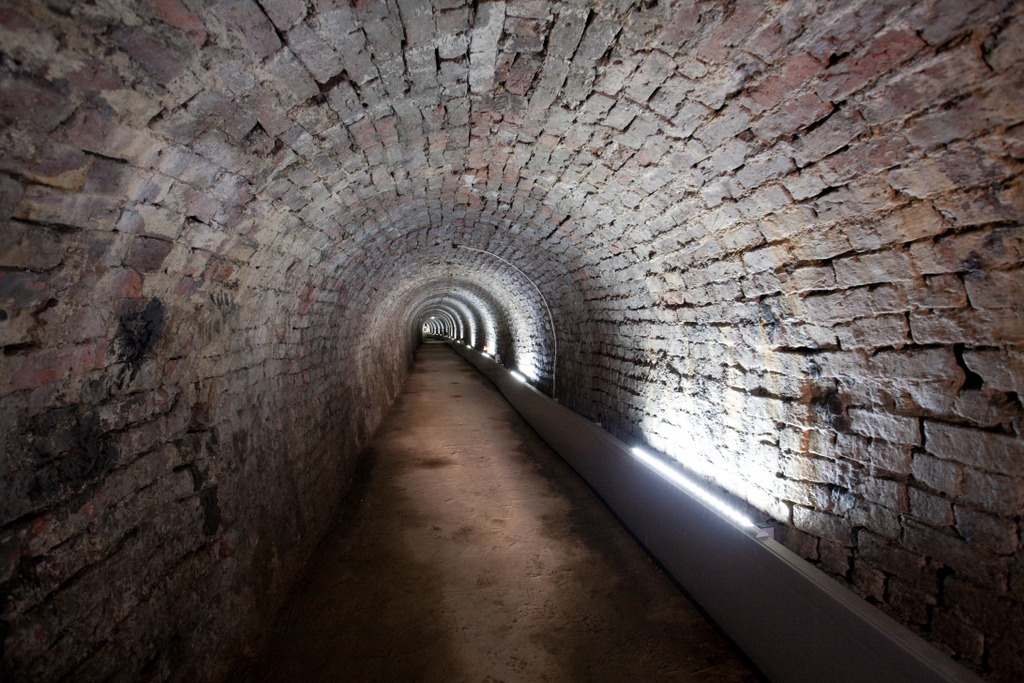
Beneath the terraced streets of the Ouseburn Valley lies a 2.4-mile subterranean waggonway, built between 1839 and 1842 to haul coal from Spital Tongues colliery down to the Tyne. When the Luftwaffe turned its attention to Tyneside during the Second World War, sections of the tunnel were hastily converted into air-raid shelters for 9,000 people. The guided tours, run by the Ouseburn Trust, bring both chapters of the tunnel's life into vivid focus. You meet at 55 Lime Street for a safety briefing before descending into the gloom, where wartime sirens, recorded memories, and the sheer weight of earth above your head combine into something genuinely atmospheric. During the walk you pass directly beneath Hadrian's Wall without ever seeing daylight. Tours run regularly but must be booked in advance; expect to pay around 14-16 pounds for adults and 7 pounds for children aged 7 to 16.
How to find it: Meet at 55 Lime Street, Ouseburn, NE1 2PQ. Book via the Ouseburn Trust website.
Tyne Pedestrian and Cyclist Tunnels
Most people crossing the Tyne do so over one of its famous bridges. Far fewer travel under it. Opened in 1951, the Tyne Pedestrian and Cyclist Tunnels were an engineering marvel of their time -- 270 metres of tiled tunnel running 12 metres beneath the riverbed, connecting Howdon on the north bank with Jarrow on the south. The star attractions were always the original wooden escalators, the longest in the world when installed, with 306 steps apiece. Following a six-year refurbishment that concluded in 2019, two of the four original wooden escalators have been replaced with modern glass-enclosed inclined lifts, but the remaining pair have been preserved as engineering relics with their internal workings lit and exposed for viewing through the side panelling. It is a deeply strange and satisfying experience to descend beneath a working river, hearing the faint hum of traffic on the bridges above. Entry is free and access is available 24 hours a day.
How to find it: North entrance at Howdon (nearest Metro: Howdon). South entrance at Jarrow. Free, open 24/7.
St Mary's Well, Jesmond
Here is a place that was once ranked alongside Canterbury and St Paul's as a site of national pilgrimage -- and today has virtually no signage pointing to it. Tucked into the wooded banks of Jesmond Dene, the remains of St Mary's Chapel and its associated holy well date back to the 12th century. A holy relic connected to the Virgin Mary was once housed here, and in 1479 a Yorkshire rector left money in his will for pilgrims to visit Jesmond alongside England's greatest shrines. The well itself, with its stone arch bearing the carved inscription "GRATIA" (from "Ave Maria gratia plena"), is a later addition, but the atmosphere of ancient devotion clings to the spot like damp moss. Newcastle's Pilgrim Street takes its name from the medieval travellers who walked this route. Today, dog walkers outnumber pilgrims.
How to find it: In Jesmond Dene, off the main path near the Millfield House entrance. No signage. Free.
Curious Monuments and Street Sculptures
Newcastle's public art collection includes some genuinely odd pieces that most residents have never consciously noticed.
The Vampire Rabbit
Look up above the ornate rear doorway of Cathedral Buildings on Dean Street and you will see it: a grotesque, black-painted rabbit with bared fangs, red-stained claws, and an expression of unhinged menace. The Vampire Rabbit has perched here since the building was constructed in 1901 by architects Oliver, Leeson and Wood, staring down at the graveyard of St Nicholas Cathedral across the lane. Nobody is entirely sure why it exists. One theory holds it was placed to ward off grave robbers. Another suggests it is actually a hare whose ears were put on backwards, referencing the surname of a local doctor and Freemason, Sir George Hare Philipson. A third, less exciting hypothesis is that it simply symbolises spring. Originally the same sandstone colour as the building, it was painted its current sinister black in 2008. Whatever its origins, it remains one of the most delightfully bizarre things in any English city. Free -- just look up.
How to find it: Above the rear doorway of Cathedral Buildings, 27 Dean Street, NE1 1PG, facing St Nicholas Cathedral.
Man with Potential Selves
Three painted bronze figures stand along Grainger Street, one of Newcastle's busiest pedestrian thoroughfares, and the remarkable thing is how few people notice them. Sculptor Sean Henry created them in 2003 for the Grainger Town Partnership: the Standing Man, the Walking Man, and the Floating Man. Each is 2.5 metres tall, depicting the same unremarkable-looking bloke in different states of being. The Floating Man is the showstopper -- mounted on a barely visible steel support, he appears to hover above the pavement in a state of peaceful levitation. Thousands of shoppers and commuters pass these statues daily. Most do not break stride. Once you see them, you will never unsee them.
How to find it: Grainger Street, near Central Station. Three separate figures along the pedestrianised stretch. Free.
River God Tyne
Mounted high on the south-facing wall of Newcastle Civic Centre is one of the most imposing sculptures in the North East that almost nobody talks about. The River God Tyne, created by David Wynne for the building's opening in 1968, is a 4.8-metre bronze figure weighing nearly three tonnes -- said to be the largest bronze figure in the UK at the time of installation. The god is shown in muscular human form, but his face is entirely hidden behind a curtain of cascading hair and water, giving him an eerie, elemental quality. Water flows from one outstretched hand, around the body, and down the wall. Nearby, on the same building, you will find the Swans in Flight sculpture -- another piece of civic art that deserves far more attention than it receives.
How to find it: South-facing wall of Newcastle Civic Centre, Barras Bridge, NE1 8QH. Free, visible from the courtyard.
The Blue Carpet
In front of the Laing Art Gallery on New Bridge Street sits one of the most ambitious and divisive pieces of public art in the city. The Blue Carpet, designed by Thomas Heatherwick and completed in 2001, is an entire public square paved in slabs of crushed blue glass mixed with white resin. The surface curves up at the edges like a fabric carpet being lifted by the wind, with benches that appear to fold upwards from the ground itself. Beneath them, sunken glass-topped boxes hold coloured lights. At the eastern end, a staircase was rebuilt with a curving skin of wooden ribbons, constructed by a local boatbuilder. Six years and 1.4 million pounds in the making, it divides opinion fiercely, but there is nothing else quite like it anywhere in England.
How to find it: Outside the Laing Art Gallery, New Bridge Street, NE1 8AG. Free.
Historic Survivors
For a city that reinvents itself as eagerly as Newcastle, a surprising number of ancient buildings have endured in unexpected corners.
Blackfriars
Finding Blackfriars for the first time feels like stumbling into a secret. You approach through Dispensary Lane or Monk Street, past unremarkable shop fronts, and then suddenly you are standing in the cloister garden of a 13th-century Dominican friary. Founded in 1239, Blackfriars is Grade I listed and houses what is believed to be the oldest purpose-built dining room in the UK -- the original refectory where friars broke bread more than 800 years ago. Since 2001, it has operated as a restaurant serving robust, locally sourced British food (Northumberland venison, Lindisfarne oysters). History tours with lunch are available if you want the full story. The complex also includes a cookery school, banquet hall, and meeting rooms. It is one of those places that makes you question what else might be hiding behind Newcastle's modern facades.
How to find it: Friars Street, NE1 4XN, off Dispensary Lane. Restaurant booking recommended.
Bessie Surtees House
Two beautifully preserved 16th- and 17th-century merchants' houses sit on Sandhill overlooking the Tyne, their elaborately timbered facades a rare surviving example of Jacobean domestic architecture in Newcastle. Bessie Surtees House is named for its most famous resident, who in 1772 climbed through one of those timber-framed windows and eloped with John Scott, a man her wealthy banker father considered entirely unsuitable. Scott went on to become Lord Chancellor of England, which presumably settled the argument. A cast-iron plaque below the elopement window tells the story. Inside, the restored period rooms are free to visit, run by Historic England with volunteer-led tours. It is one of those places that feels almost absurdly significant for how easy it is to walk past.
How to find it: 41-44 Sandhill, NE1 3JF. Free entry. Check Historic England for current opening hours.
Morden Tower
One of five surviving drum towers from Newcastle's 13th-century town walls, Morden Tower looks from the outside like exactly what it is: a squat, circular medieval fortification dating to about 1290. What the exterior does not tell you is that since 1964, this Grade I listed Scheduled Ancient Monument has been one of the most important poetry venues in Britain. Under the custodianship of Connie Pickard, the tower hosted readings by Allen Ginsberg (who gave his first European reading of Kaddish here and later said he "learned more reading at Morden Tower than at a hundred universities"), Basil Bunting, Ted Hughes, Seamus Heaney, Lawrence Ferlinghetti, and Carol Ann Duffy. It is a place where medieval stone walls absorbed the rhythms of Beat poetry and the Northumbrian Renaissance. The exterior is freely accessible from Back Stowell Street.
How to find it: Back Stowell Street, on the West Walls, NE1 4XW. Free exterior access; check for event listings.
Benwell Roman Temple
There is something wonderfully incongruous about finding the remains of a Roman temple to a mysterious local god wedged between semi-detached 1930s houses in suburban Benwell. The Temple of Antenociticus stood in the civilian settlement outside Condercum, one of thirteen permanent forts along Hadrian's Wall. Built around AD 178-180, it was dedicated to a deity worshipped nowhere else in the Roman Empire -- Antenociticus appears on no inscriptions from any other site in Britain or on the Continent, making this quiet cul-de-sac the only known place of worship for this god in the entire ancient world. The carved head of Antenociticus, a striking synthesis of classical and Celtic styles, can be seen at the Great North Museum. The temple ruins themselves are managed by English Heritage. Free entry, open daily.
How to find it: Broomridge Avenue, Benwell, NE15 6QE. Free, managed by English Heritage.
The Weight of the Past
Some places carry their history more quietly than others.
Ballast Hills Burial Ground
You could walk across Ballast Hills without knowing you were treading on one of Newcastle's largest burial grounds. Today it is a flat, unremarkable patch of green space in the Ouseburn Valley -- a place where children play and people cut through on their way somewhere else. But between 1609 and 1853, more than 40,000 people were buried here, earning it the grim nickname "Plaguey Fields." The site was first used during the plague year of 1609, with further mass burials in 1625, 1636, and 1665. By the 18th and 19th centuries, roughly half of all Newcastle's dead -- the poor, the nonconformists, the unclaimed -- ended up here. In 1929, the headstones were cleared and it was turned into a playground. There is almost nothing to tell you what lies beneath.
How to find it: Off Lime Street in the Ouseburn Valley, NE1 2PQ. Free, always open.
The Lit and Phil
The Literary and Philosophical Society of Newcastle upon Tyne has occupied its Westgate Road premises since 1825, but the institution dates to 1793, when it was founded as a "conversation club" by the Reverend William Turner -- more than fifty years before the London Library opened its doors. It remains the largest independent library outside London, housing over 200,000 volumes in an interior of soaring bookshelves, galleried reading rooms, and the particular silence of a place where people have been thinking for two and a quarter centuries. Its greatest claim to fame: on 3 February 1879, Joseph Swan demonstrated his incandescent light bulb to a packed lecture of around 700 people, with Sir William Armstrong in the audience. On 20 October 1880, Swan returned to light the Lit and Phil's lecture theatre by electricity, making it one of the first public rooms in the world to be lit by electric light. Armstrong would go on to light Cragside with Swan's invention. You can visit for free -- just walk in off Westgate Road and let the hush envelop you.
How to find it: 23 Westgate Road, NE1 1SE. Free to visit during opening hours.
Across the River: Gateshead
Gateshead often plays second fiddle to its neighbour across the Tyne, but it holds its own share of overlooked treasures.
Dunston Staiths
The largest timber structure in Europe stretches 500 metres along the south bank of the Tyne at Dunston, and most Newcastle residents have never set foot on it. Dunston Staiths was built in 1893 to load coal from the North Durham coalfield onto ships. At its peak in the 1920s, 140,000 tons of coal per week passed along its wooden decks -- a staggering volume that helps explain both the region's industrial wealth and the scale of its environmental scars. The staiths fell out of use in the 1970s and suffered serious arson damage in May 2020, but reopened to the public in April 2024 following restoration work. It is now both a Scheduled Ancient Monument and a Listed Building. Seasonal guided walks are offered, typically on the first Saturday of the month from May to September. Standing on its weathered timbers with the Tyne flowing beneath your feet is as close as you can get to touching the industrial age.
How to find it: Dunston, Gateshead, NE11 9DS. Off the Keelman's Way riverside path. Free access; check website for guided walk dates.
Saltwell Towers
Hidden in the heart of Gateshead's Saltwell Park stands a building that looks like it was teleported from a fairy tale. Saltwell Towers is a dark red and yellow brick Gothic Revival mansion built in 1859 for William Wailes, a distinguished stained glass manufacturer. With its asymmetrical towers, corner turrets, and tall chimney stacks, it would not look out of place in a Bavarian forest. The building served as a First World War hospital, then a museum from 1933 to 1968, before falling into severe disrepair. A major restoration of the wider Saltwell Park, funded by a 9.6-million-pound grant from the Heritage Lottery Fund and Gateshead Council, brought it back to life, and it reopened in 2004. Today it houses a cafe, local art, a stained glass centrepiece commissioned to honour Wailes's legacy, and an exhibition on the park's history. Entry is free.
How to find it: Saltwell Park, East Park Road, Gateshead, NE8 4RH. Free entry.
Before You Go
A few of these places operate on limited or seasonal schedules, so it is always worth checking ahead. The Victoria Tunnel tours sell out quickly in summer. Bessie Surtees House keeps weekday-only hours. Dunston Staiths opens for guided walks only on specific dates. But the beauty of most entries on this list is that they ask nothing of you except curiosity and a willingness to look at familiar streets with fresh eyes.
Newcastle and Gateshead are cities that reward the attentive. The grand landmarks will always be there, gleaming on the quayside. But the vampire rabbit, the forgotten burial ground, the tunnel beneath the river, the library where electric light first flickered into existence -- these are the places that give a city its soul.